Skip to content
Computer vision

Shot Reader v2 - smart video analysis for 3D and generation

2 min readupdated

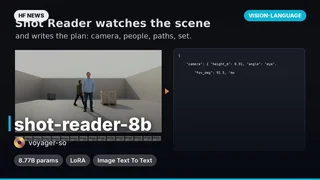
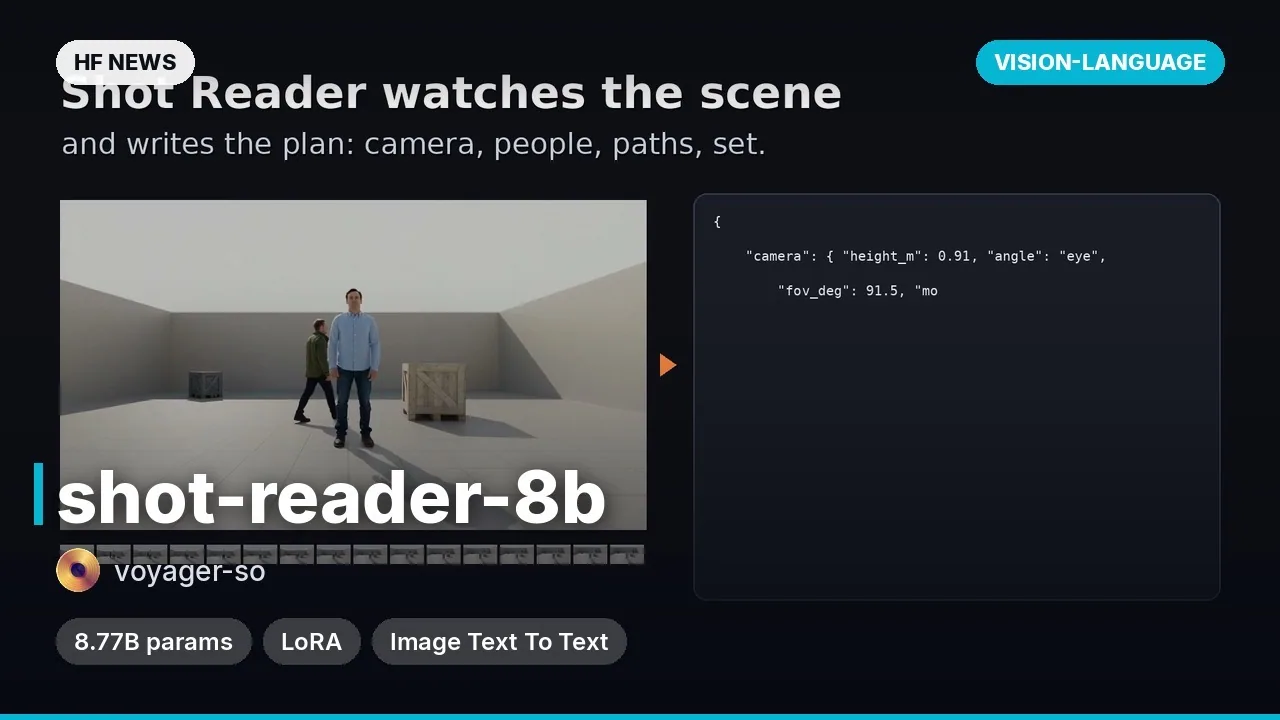
The Shot Reader v2 model is designed for the automatic analysis of video frames and converting them into detailed JSON specifications. It determines camera height, angles, optics, object movement trajectories, environment, and style, outputting data that can be directly used in 3D editors like Blender. Based on the Qwen3.5-9B architecture (a language model with 9.4 billion parameters), it specializes in complex cinematic tasks such as precisely separating optical zooming from physical camera movement (dolly). The tool is useful for video editors, 3D artists, and virtual production pipeline developers.

Key features

  • Zoom vs. dolly: Accurately separates focal length changes from camera movement, where standard models often make mistakes.
  • Movement and height analysis: Reliably determines static and tracking shots, as well as shooting parameters for real scenes and animations.
  • Metadata and tags: Automatically generates text descriptions (captions), scene tags, and model confidence scores for each parameter.
  • Format for 3D: Outputs structured data on object coordinates in meters on a plane for scene reconstruction.

What you can do

  • Scene previsualization: Use the model's JSON output for the quick assembly of basic blocking and camera movement in Blender.
  • Video archive cataloging: Automatically label entire libraries of clips by tags, style, movement type, and frame content.
  • Integration into agents: Connect the model via API or the Voyager system to automate scene work in chatbots and development environments.

Example

Example of calling the script to analyze a specific video clip while specifying the main object in the frame:

python shot_reader.py clip.mp4 --subject "P01: person (woman in a red coat)"
Read moreDetails
• Benchmarks: Zoom recognition in a 300-clip test is 95% (compared to 48% for alternatives), and handheld motion detection is 92%.
• System requirements: Model weight is 18 GB; on a graphics card with 16 GB VRAM, execution is possible in 4-bit mode (with a minor loss in accuracy) or via the vLLM backend.
• Training: Fine-tuning (LoRA r64) of the base Qwen3.5-9B language model with an unchanged visual encoder on synthetic and real datasets.

Video example
Discuss Telegram 3 38

Will it run?

Runs in BF16

Fits without quantisation.

  • BF16weights 18 GB · ready files20 GB
  • FP8 / INT8recommendedweights 8.8 GB10 GB
  • 4-bitweights 4.9 GB5.9 GB

Tip: go 8-bit.FP8 / INT8 is within about a percent of full precision in quality, takes half the memory and runs faster on RTX 40/50 and H100. Full precision only pays off for fine-tuning.

What to get for this model

Massed ComputeOpen Massed Compute

Your own GPU: FP8 / INT8 — from RTX 2080 Ti · BF16 — from RTX 4090

Massed Compute hourly prices, November 2026. The discounted price applies with the coupon at checkout.

Estimate: weights plus working memory. Long videos, high resolutions and long contexts need more.

Run it on Massed Compute

The script downloads the model to the rented machine. How to run it is in the model card.

  1. 1. Rent a machine with a fitting GPU

    Open Massed Compute
  2. 2. Paste the script into the machine's terminal

    Connect over SSH (the Massed Compute panel shows the command) or open a terminal on the machine's desktop.

    HF_TOKEN / CIVITAI_TOKENThe script starts with token lines: paste yours between the quotes. The Hugging Face token is for gated models, the Civitai one for Civitai models.

    # voyager-so/shot-reader-v2
    mkdir -p ~/models
    curl -LsSf https://astral.sh/uv/install.sh | sh
    source "$HOME/.local/bin/env"
    uv tool install "huggingface_hub[cli]"
    hf download voyager-so/shot-reader-v2 --local-dir ~/models/shot-reader-v2
    # The model is in ~/models. How to run it is in the model card (link above).
    Add more LoRAs to shot-reader-v2
  3. 3. Use it

    The model is in ~/models. How to run it is in the model card (link above).

Stop the machine in the panel when you are done: it bills by the minute while it runs.

How to speed it up

Picked for this model type. Choose your hardware above to see what fits you exactly.

  • FlashAttention 44.0.0b40from November 18, 2026new release

    fastest exact attention on B200

    Kernels for Blackwell (beta). Exact attention without quantisation — fine for everything, LLMs included.

    How to enable: pip install flash-attn-4; vLLM and SGLang pick it up themselves.

    Earlier generations (2)
    • FlashAttention 3 — The Hopper (H100/H200) version with FP8.
    • FlashAttention 2 — The standard for RTX 30/40/50 and A100: exact attention without the memory cost of long contexts.
  • torch.compile2.15.0from October 28, 2026new release

    10–30% for free

    Compiles the model for your GPU. Slower first run, faster afterwards.

    How to enable: model = torch.compile(model); in ComfyUI the TorchCompileModel node.

Model family

  1. Qwen3.5-9B-Basefamily root
  2. Qwen3.5-9B
  3. shot-reader-v2

New posts about versions of Qwen3.5-9B-Base (quants, finetunes, LoRAs) will show up under the bell.

Quantised versions 12All on Hugging Face
Fine-tunes 12All on Hugging Face
LoRAs and adapters 6All on Hugging Face
Merges 1All on Hugging Face

About the model

voyager-so/shot-reader-v2
Author
voyager-so
Category
Computer vision
Released
Posted

On NeyroLearn

Hugging Face

383

Ask AI about this model

Answered by Gemini 4 · the chat is kept only in this tab

Comments