LFM-3-Coder-Claude-Distill
a compact model for coding and logic
2 min readupdated
This lightweight 1.73B-parameter language model is fine-tuned for programming tasks and step-by-step reasoning. Built on LiquidAI/LFM3-1.7B, it was distilled (transferring capabilities from a larger model to a smaller one) using reasoning traces and responses from the Claude model family — Sonnet, Opus, and Fable. Unlike the base model, this fine-tune specifically learns to build a chain of thought before outputting code. It is a solid fit for developers who need a fast local assistant for basic coding on modest GPUs.
Key features
- Reasoning-focused: trained to break down problems step by step, mimicking Claude's analytical and response-structuring style.
- High inference speed: thanks to its compact 1.73B size, it can hit over 200 tokens per second on an RTX 4060.
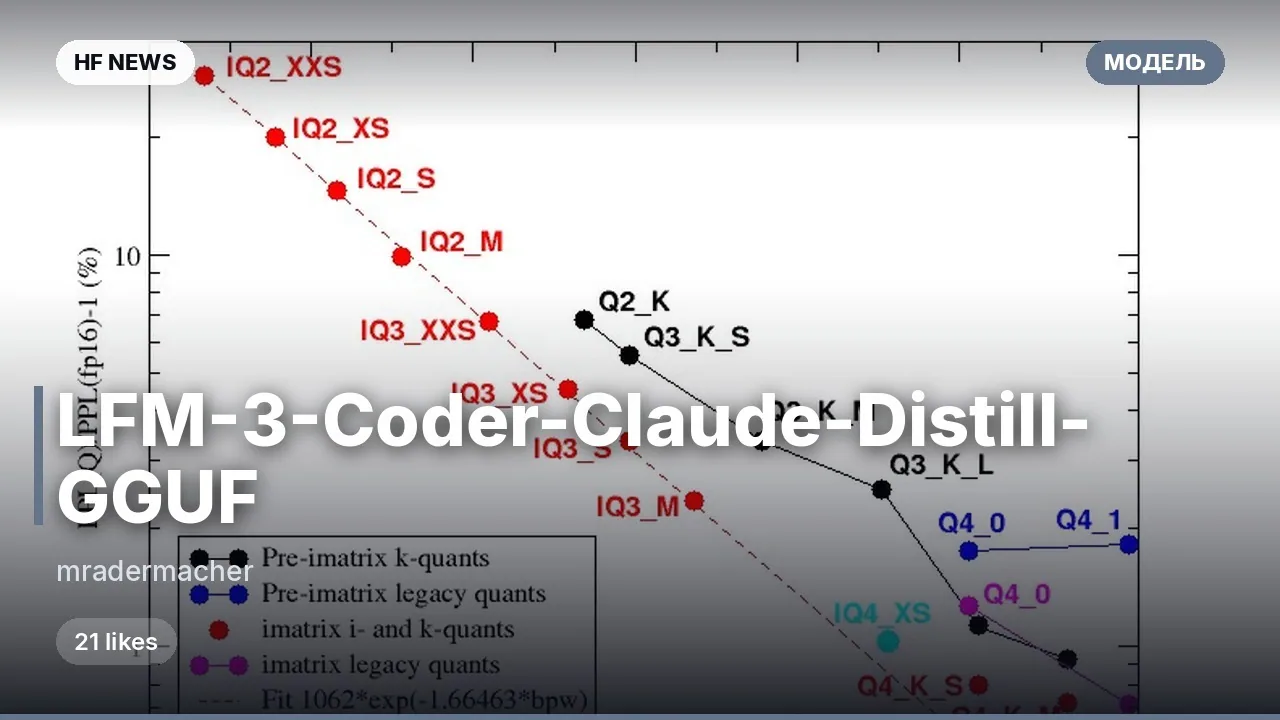
- Ready-to-use weight formats: the repository includes both full FP16/BF16 safetensors weights and a quantized GGUF version (
Q4_K_M) for easy local deployment. - Permissive license: released under Apache-2.0, allowing free use in both personal and commercial projects.
What you can do
- Load the GGUF version (
Q4_K_M) into a local client for tasks like code autocompletion or explaining short English code snippets on a laptop or PC with an entry-level GPU. - Integrate the model into a local script or side project via
transformersorUnslothto generate code along with step-by-step logic breakdowns. - Run it in 4-bit quantization to quickly prototype pipelines that demand high token generation speeds with minimal VRAM usage.
Example
from unsloth import FastLanguageModel

model, tokenizer = FastLanguageModel.from_pretrained(
    model_name = "Schnuckade/LFM-3-Coder-Claude-Distill",
    max_seq_length = 4096,
    load_in_4bit = True,
)
Read more
DetailsBase model: LiquidAI/LFM3-1.7B (1.73B parameters); training framework: Unsloth.
Generation speed: over 200 tokens/s on an RTX 4060.
Language: English (en); max context length in the example: 4096 tokens.
No benchmarks are listed on the model card.


Comments