Article
How We Accelerated MiniMax H3 in ComfyUI on NVIDIA Blackwell
FlashAttention-4 84,14 s 1,01× Base PyTorch SDPA 85,07 s 1,00× We expected more.
prisstik Founder@prissetik
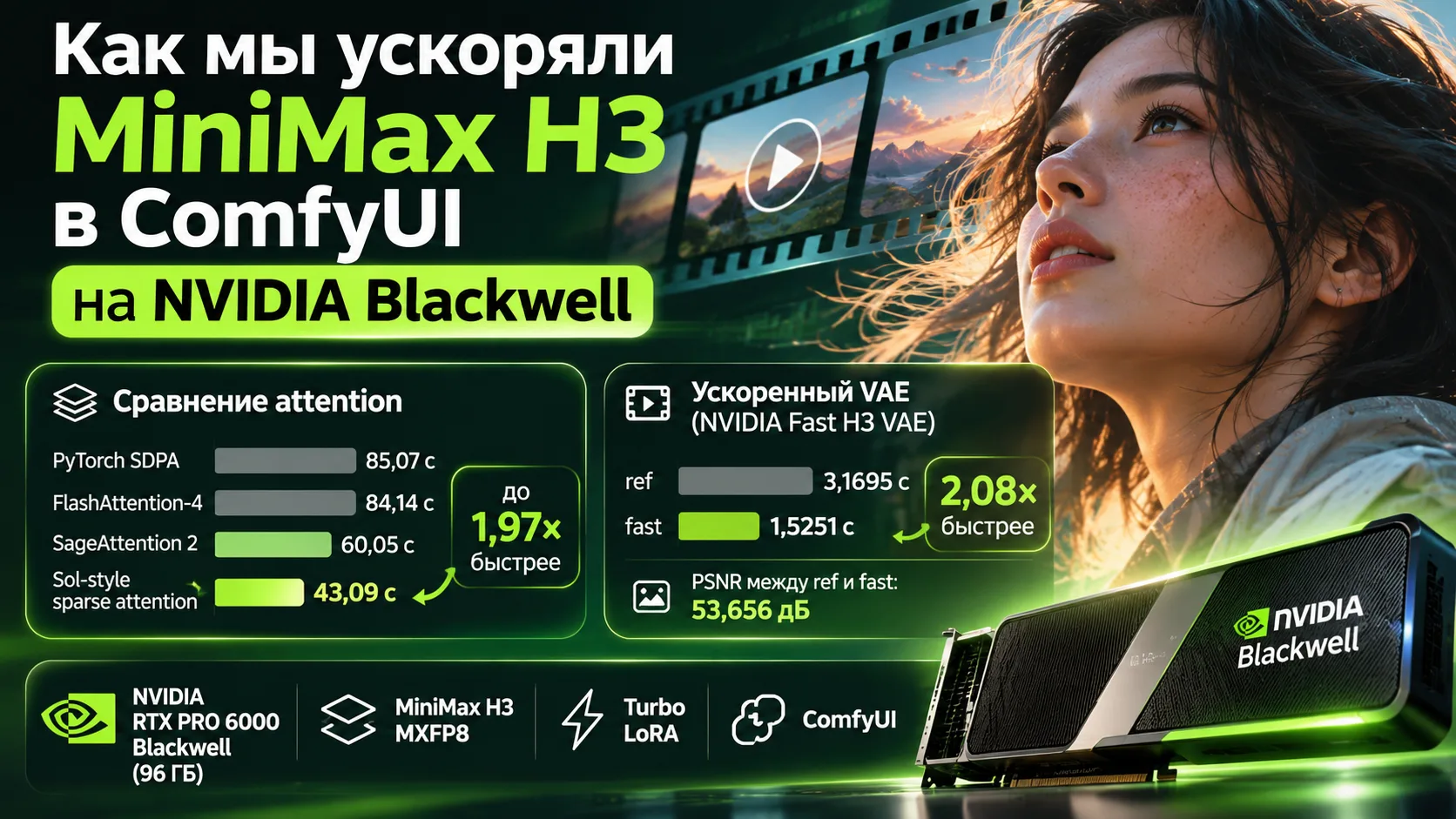
We decided to test how much video generation with MiniMax H3 could be accelerated using NVIDIA optimizations and different attention implementations directly within ComfyUI.
For our tests, we used an NVIDIA RTX PRO 6000 Blackwell with 96 GB of VRAM. We were interested not just in running the model, but in understanding which optimizations actually help in a specific workflow and what effect each one provides individually.
We started with the MiniMax H3 model in MXFP8 format, applied Turbo LoRA, and compared several attention variants. After that, we separately tested the accelerated NVIDIA Fast H3 VAE video decoder.
Attention Comparison: From 85 to 43 Seconds
For the first test, we used identical settings: a resolution of 1344 × 768, 124 frames, 10 generation steps, and the same seed. The model was preloaded, and we conducted three measurements for each variant. The table shows the median.
This measured latent generation time: VAE decoding, upscaling, and video saving are not included in these figures.
| Attention | Median Time | Speedup Relative to Base Variant |
|---|---|---|
| Base PyTorch SDPA | 85,07 s | 1,00× |
| FlashAttention-4 | 84,14 s | 1,01× |
| SageAttention 2 | 60,05 s | 1,42× |
| Sol-style sparse attention | 43,09 s | 1,97× |
The most noticeable result in this test was sparse attention: the latent generation time was cut almost in half compared to the base variant.
It is important to clarify that we tested Sol-style sparse attention via the BlockSparseAttention implementation built into ComfyUI. We looked at Kijai's standalone ComfyUI-SolAttn_triton project, but the 43,09 seconds figure specifically refers to the tested BlockSparseAttention variant.
- Kijai's ComfyUI-SolAttn_triton — https://github.com/kijai/ComfyUI-SolAttn_triton
The FlashAttention-4 result initially seemed suspicious: the difference from the base variant was less than a second. Upon verification, it turned out that in the default configuration, PyTorch was already using an efficient flash attention. In other words, we were comparing two optimized implementations rather than FlashAttention-4 against a slow unoptimized attention.
This does not mean FlashAttention-4 is useless. It means that in our specific test, replacing the already working flash attention provided a small boost. With other data shapes, models, and configurations, the result may differ.
For MXFP8, we also checked actual execution: the model was loaded in this format, and computations used scaled_mm_mxfp8. In a separate check, the standard path took about 85,09 s, while forced emulation took 101,36 s. These were single measurements after warmup, so they should be taken as a preliminary check rather than a full statistical comparison.
Accelerated VAE: 3.17 Versus 1.53 Seconds
As a next step, we separately tested NVIDIA's Fast H3 VAE. The VAE turns the generated latent into finished frames, so its speed also affects the total video generation time.
For the test, we created separate ComfyUI nodes and compared two modes of the same Fast H3 VAE on a single latent:
- ref — the reference implementation of Fast VAE on PyTorch.
- fast — NVIDIA's accelerated implementation using FlashAttention-4, quack, Triton, and CUDA Graph.
Both modes used the same weights. We performed a warmup, after which we conducted three measurements on a latent sized 1344 × 768 with 124 frames.
| Mode | Measurements | Median |
|---|---|---|
| Fast VAE ref | 3,1682 / 3,1695 / 3,1706 s | 3,1695 s |
| Fast VAE fast | 1,5242 / 1,5251 / 1,5256 s | 1,5251 s |
The accelerated mode decoded the same latent approximately 2,08 times faster. The time includes decoding and frame conversion, but does not include initial weight loading, warmup, latent generation, and video saving.
We also compared the resulting frames: the PSNR between ref and fast was 53,656 dB. This shows how close the results of the two implementations of the same Fast H3 VAE are on our test latent.
There is an important limitation here: we did not compare Fast VAE with the full original MiniMax VAE. NVIDIA notes that the Fast H3 VAE itself is an approximation relative to the released full decoder; the 53,656 dB we cited refers only to the comparison between the two Fast VAE modes.
- NVIDIA's Fast H3 VAE Description — https://github.com/NVlabs/Sana/blob/sol-engine/models/Open-H3-Regenerate-2K/README.md
What We Achieved
In our configuration, sparse attention provided the most significant generation speedup: from 85,07 to 43,09 seconds for the latent. Separately, the accelerated Fast H3 VAE engine reduced decoding time from 3,17 to 1,53 seconds.
These figures cannot be directly taken as the total time for a finished video or applied to any model and GPU. These are measurements of individual parts of a specific workflow on an RTX PRO 6000 Blackwell. In addition, we have not yet conducted a full evaluation of the visual quality of sparse attention across a wide set of scenes—speed must be considered alongside such verification.
For us, the main takeaway is that optimizations should be measured individually. A technology name by itself does not guarantee identical speedup: the result depends on what the base engine is already doing, what data sizes are being processed, and which part of the pipeline is the bottleneck.
Project Links
- NVIDIA Sol Video Inference Engine — https://nvlabs.github.io/Sana/Sol-Engine/
- NVIDIA Open-H3-Regenerate-2K and Fast H3 VAE Description — https://github.com/NVlabs/Sana/blob/sol-engine/models/Open-H3-Regenerate-2K/README.md
- NVIDIA Open-H3-Regenerate-2K Weights on Hugging Face — https://huggingface.co/Efficient-Large-Model/Open-H3-Regenerate-2K
- ComfyUI-Open-H3-Regenerate — https://github.com/rdh9616/ComfyUI-Open-H3-Regenerate
- Kijai's ComfyUI-SolAttn_triton — https://github.com/kijai/ComfyUI-SolAttn_triton
- FlashAttention — https://github.com/Dao-AILab/flash-attention
- SageAttention — https://github.com/thu-ml/SageAttention
- #minimaxh3
Comments